Tuesday, October 15, 2013

Living out of my subaru, and my entry into the car commuter class

For the first 40 days of this semester, I lived out of my car while working a day job in Flagstaff.  This post is about how I dealt with the lifestyle, what I enjoyed about it, and what started to drive me nuts 5 weeks in (it might surprise you).

First off, the idea of living in the woods is about money, but it's not just me being cheap.  I'm generally just not that satisfied with paying rent.  I'd much rather buy a plot of land, build a shell of a house, and live in it while I finish it.  If I'm going to pay a monthly payment, I'd rather it be towards equity.  Also, Flagstaff has a lot of totally legal forest service camping, as long as you don't go over 14 days in a month.  Since I had three-day weekends and spent them climbing and hiking, that wasn't a huge problem; the rangers aren't sticklers about it if you don't trash up a spot.  But enough prelude, on to the details.

When I first decided that it wasn't worth paying rent in Flagstaff, my first worry was about comfort.  Not comfort in terms of sleeping; I know and trust my sleeping bag.  But comfort for me also includes being organized.  It means that in my daily life I know where the things I need are, and don't go thrashing through half of my stuff to find things on a routine basis.

So my first step was to go to the used gear store in town and sell off some of my excess gear.  The next was to rent a small (4 foot cube) rental space to store things I wouldn't need in the next few months (which makes you wonder, do I really need them at all?).  Having downsized my belongings, I set about making my car more comfortable to live in, by building some pull-out shelves from my sleeping platform.  My propane stove was parked on one side of the platform, and the shelves provided instant work space for cooking.  A small propane tank on the roof connects to the stove with a hose.  I dedicated one part of the storage space under the platform to my kitchen, and while I still haven't figured out the best way to organize that, it's a lot better than having no organization at all.

So with comfort more or less out of the way, the first challenge came: loneliness.  I'm a social person, and I like to have a sense of community.  This is something that was lacking even when I lived in my last house in Flagstaff, but I had Becky with me then.  For my first four weeks living out of my car this semester, she was out leading Prescott College's wilderness orientation.  So it was me, in my car, living out in the woods.  Getting out there at 9:30 or 10 o'clock after my night classes, after dark even in August.  Not ideal by any means.  I like to cook, but cooking for one person just isn't that satisfying.  And the night classes make it even harder.

Fortunately, the college provided some of the community that I'd otherwise be lacking, and I met up with a couple of new climbing partners.  It's not the same as living in a good house, but I felt better than I did when this started.  And I spent my three day weekends going on climbing and hiking trips (the grand canyon three weekends in a row before the shutdown), so the camping and working in town was really just a half time thing.  I started to enjoy waking up and doing homework in the woods, setting up a little office with my camp chair and my laptop or my kindle.  All things considered, the living part of living in the woods got easier over the weeks.  I could easily see myself living out of it again for a summer, when the weather is nice and the days are long.  Maybe a climbing summer next year?

So now for the worst part of subaru life.  It wasn't comfort, or loneliness, but driving my car every day.  That's really it.  Even though Flagstaff has the best free camping of anywhere I've ever been (I could give you complete directions to a half dozen forest service sites off the top of my head, all within 10 miles), none of them are quite close enough for me to bike into work every day.  I don't really want a 5+ mile commute back from night classes especially.  So I found myself, overnight, having joined the world of car commuting.  Years ago, I swore I'd never commute by car on a daily basis.  I like the exercise that I get from my bike, and I don't think it makes sense to spend so much energy driving around in our daily lives.  Driving this much doesn't feel particularly good, and I feel isolated from the town.

Now I'm living in a house within easy walking of downtown, and no more than 2 miles to either of CCC's campuses.  I'll have some late-night rides home, but nothing terrible.  And most importantly, I can give my subaru a rest for a day.  I think there was a point where it had been driven every day for over a month; I think this is the first time I've ever done that in my life.

Saturday, August 31, 2013

Sourdough Apple Pancakes

I almost never make "normal" pancakes anymore.  Just like I don't make plain cheese quesadillas.  I'm always after something interesting to add.  So here's my recipe for sourdrough pancakes, with apples added - but I'll put a list in at the end of all sorts of other fun things that I've mixed in recently, too.

First, you need a sourdough starter.  I got mine by mixing flour and water and waiting until it got bubbly, then feeding it periodically.  There are all sorts of recipes online about making and feeding starters, but I'm about as lazy as it gets.  I keep mine in a sealed glass jar and feed it whenever I use it, and occasionally otherwise.  I never measure what I add to it.  I've let it go for a week or more at room temperature and had no problems using it in a recipe.  It helps that all of my recipes involve long, overnight fermentations; plenty of time for whatever yeast and lacto-bacilli remain in my neglected starter to recoup, multiply and ferment.

Once you have the starter, the recipe for the pancake batter is quite simple.  This is enough for one hungry 27-year-old male:

  • 1 cup/4 oz flour
  • 1/2 cup/4 oz water
  • 3 grams of salt
  • 1 egg (you can at least triple this recipe without increasing the number of eggs)
  • 1 tablespoon of neutral flavored oil (or mix in melted butter in the morning)
The night before, mix all the ingredients in a bowl.  Use a whisk if you have it and mix just enough for everything to combine.  And when I say just enough, I mean just enough.  Shoot for 10 seconds.  Leaving a few lumps is A-ok, they'll cook out.  Optionally spritz the top with oil (see my bread post for a DIY oil spray) to keep a skin from developing overnight.  This is only necessary with low humidity.  Cover with a cloth and leave at room temperature.

In the morning fry up some sliced apples in butter on medium heat (I sliced two small apples for this):


Fry until the apples are soft and browned, about 10 minutes.  Stir every couple of minutes to avoid burning.  Transfer to another container and start making pancakes!


You can either add the apples to individual pancakes, as I did here, or mix them in with the batter.  If you add individually, make sure to press them down into the batter a bit so that they don't fall out when you flip the pancakes.

Once your pancakes are set around the edges (a couple of minutes), flip them and cook another minute to finish.  Plate and serve with whatever toppings you feel like; I recommend plain yogurt, but this morning I had none and used strawberry jam instead:


And there you have it.  Here's a list of other ingredients I've added to pancakes this summer, or that I've thought of but haven't tried yet:
  • Shredded carrots (it might sound odd, but it works, especially when combined with bananas)
  • Bananas
  • Shredded cucumber (In small amounts.  I haven't tried this one yet)
  • Any kind of dried fruit, added to the batter the night before
  • Any kind of nuts, added in the morning

Friday, December 28, 2012

My (Possibly Optimal) Bread Process

As I'm home for the holidays now, I lack photos of most of the process described here.  When I next bake bread, I'll take some pictures.


AKA, How to make good bread as easily as possible.

Like any geek, I enjoy a good optimization problem.  I especially enjoy those that involve routine kitchen tasks.  One thing that I've added to my list in the last few months is baking bread.  While in Europe this year I learned a German recipe for a whole wheat spelt loaf, and since I got back to the States in August I've been making it weekly, trying to perfect it.  My criteria to optimize are as follows:

  • All flour must be fermented for several hours with a sourdough starter 1
  • It must be primarily whole wheat spelt
  • It must have a good, hearty crust
  • It doesn't have to be as light as a loaf of white bread, but it must not be super dense and gummy
  • While satisfying the above, it must be as easy to make as possible
The  recipe I learned in Europe was super-simple already; it involved only two mixings of ingredients, no kneading, and the most time-consuming part of it was greasing the bread tins. But it still seemed, well . . . sub-optimal.

The first change I made was to mix all of the ingredients in at the beginning.  This is a good idea not just to make it easier, but so that all of the flour in the recipe has a chance to undergo a long fermentation, something that I consider essential to producing truly healthy bread.  I may be missing a nuance in the final product by skipping a step, but it still makes a good loaf.

The second change I made was to measure by weight instead of volume.  Apart from being much more accurate, measuring by weight is just easier and creates fewer dishes.  I put a large mixing bowl onto my scale, pour in flour until it reads the correct weight, then zero the scale.  I move the whole thing to my sink, turn on the faucet and watch the scale.  When the water is done, I pour on the salt, again watching the scale.  The one thing I don't measure is my starter. I don't think the amount of starter makes much of a difference with such a long fermentation.

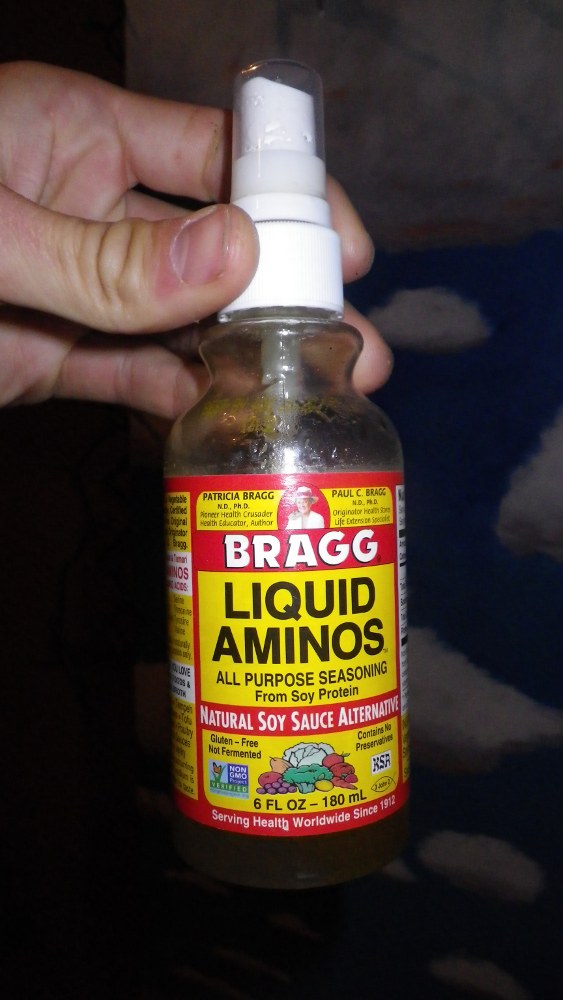
The final change I made was to simplify the greasing of the bread tins.  Instead of using butter or oil spread around with a finger, I found out that you can use a spray bottle filled with a mix of oil and water 2.  Then I put some flour in a small metal strainer and shake it over the tin to evenly distribute it.

Bragg's makes a spray bottle for soy sauce that's perfect for greasing tins.

I've made this bread about once a week for the last four months, and I think it's about as good as it can get.  I could probably put in some more effort to get a slightly better product, but I don't think it would be worth it.  So enough introduction, here's the recipe!

Ingredients (makes one loaf):
  • 500 g whole wheat flour 3
  • 500 g water
  • 10 g salt
  • sourdough starter
  1. Mix all of the above together in a bowl, then ferment at room temperature, covered with a cloth, for 12 hours or so.  You might need to add a bit of water to the dough; you want it wet enough that you couldn't knead it, but not watery (otherwise it'll take forever to bake).
  2. Put some of the dough back into your sourdough starter container.  It's too easy to forget this.
  3. Grease a 9x5 bread tin.
  4. Stir the dough to collapse large air bubbles, then ladle into the tin.  Cover the pan with a cloth or spritz it with oil to keep the top from drying out.
  5. After 30 minutes, start preheating your oven to 450 F.
  6. After another 30 minutes, check on the loaf.  Keep checking every 15 minutes until it has risen enough that if you poke it it makes a depression which holds its shape.
  7. Place the loaf in the oven and set a timer for 30 minutes.
  8. After 30 minutes, the crust of the loaf should be set.  Open the oven door and place a probe thermometer into the center of it.  Set the timer to go off at 200 degrees Fahrenheit (I do 195 in Arizona at 7000 ft of elevation).
  9. When the thermometer goes off, take the bread out of the oven, run a knife along the side of the tin, and then invert it to drop the loaf out.  Let it rest on a cooling rack 4 for several hours before cutting open (I think it's best to wait an entire day).

 Footnotes:
  1. I haven't been able to find conclusive evidence that soaking improves bread's digestibility.  However, there's plenty of evidence that sourdough fermentation is a healthy thing.  I personally think that the rise in rates of gluten intolerance in developed countries may have something to do with an overall decrease in bread fermentation times. Just a hypothesis.
  2. If you read the post I linked to, you'll note the concern about sanitation.  It's always good to be safe, but in this particular case I don't worry too much.  The botulism toxin is destroyed by 5 minutes at 190 degrees Fahrenheit, which is easily reached on the outside of my bread during baking.
  3. I prefer spelt flour, but you can use rye or whole wheat.  I haven't gotten a satisfactory rye loaf yet from this recipe, but I also haven't experimented enough with it.  If you decide to use  white flour, you'll need to reduce the water drastically (probably to 60% of the flour weight).
  4. A collapsible steamer basket is a nice cooling rack substitute.

Thursday, December 20, 2012

Fat Washing Jar Lids

Reduce, reuse, recycle, right?  Many of us strive to do things in that order, and one of the best things to reuse is glass jars.  You can buy things in bulk with them, ferment things in them, store leftovers, make yogurt, etc.  Glass is totally non-reactive, doesn't hold odors, and lasts forever.

However, as good as glass jars are, their lids can absorb odors from food, especially from things canned in them.  Pickle and salsa jar lids have particularly strong odors.  These flavors will assert themselves into whatever food you put in them - trust me.  These jars tend to be great shapes for re-using, which makes this all the more frustrating.  After a couple recent rounds of pickle-flavored yogurt, I abandoned hope that repeated batches would rid the lid of it's flavor, and started researching ways to solve the problem.

I found my answer in the book Cooking For Geeks by Jeff Potter.  He has a section on "Fat Washing".  He was talking about fat washing alcohols, to either remove unwanted flavors, or to infuse flavors from fat into alcohol (think "hot butter rum" or bacon whiskey).  I knew from reading other cooking books that many flavors (and vitamins, for that matter) are fat or alcohol soluble, and don't dissolve into water.

So I did a little experiment.  I put some lard into a pickle lid, put it on a rack on top of the wood stove, and kept it there for two days.  Then I wiped the excess off and washed the lid clean.  And guess what?  It totally worked!  There was no noticeable pickle smell remaining.  And no lard smell either.  I've since used this technique for salsa lids as well, with the same result.
Lard melting in a lid on the wood stove.

I'm not sure if the warming step is necessary for other oils - lard has to be warm to stay liquid, but it may be that if you used an unsaturated vegetable oil, you could do this at room temperature.  It stands to reason that hotter oil could absorb more flavor, however.  I also don't know if it really needs two days for it to work.  And I'd like to try alcohol-washing, using vodka or everclear instead of fat.

What I do know is that now I can reuse my glass jars without fear of creating pickle-yogurt.  Or salsa-raisins.  Or...you get the picture.

Wednesday, December 30, 2009

Onward Bound

The numbers weren't on our side today - 1000 meters up and down.  But the trail wasn't going to weave up and down like yesterday, and we had the benefit of knowing what was coming.  We were starting from Totora, at 3600 meters, heading up to Yanama pass, at 4600 meters (around 15,000 feet) and back down to Yanama village, also at 3600.  And all this with full packs.

Speaking of which, after the first 5 minutes, my pack felt like it weighed 60 pounds instead of 30.  My legs were sore and my thighs ached with every step.  But I kept going slow and steady, never running out of breath, and I soon felt better.  Or at least, my legs got numb to the pain.  I took breaks only when nature called, and took off my pack only once, to change some layerage.  Before I knew it we were in the final stretch:


I was setting a personal altitude record with every step, and soon enough we were at the top.  It was cold and windy, so we headed down immediately, took a break for lunch, and then descended the rest of the 1000 meters down to Yanama.


Once there we procured another cheap floor and began the search for donkeys.  We were pretty beat up, and from what we'd heard a day's use of donkeys would be about half as expensive as buying a day's food from a village.  Unfortunately, at this point we were pretty much down to dollars, and it's pretty tough to pay with dollars when the nearest money-changer is 2 days away.  But the kids at the house we were staying (maybe 15 years old?) agreed to take us to Meizcal, a 4-hour walk.  20 dollars seemed pretty steep, so we negotiated to include some snacks in the deal as well.

It was looking like we might make it.  It would be really, really tough, but certainly possible.  We'll never know, though, whether we could've made it, because fate intervened that night.  David woke up with a fever, and that morning said that he felt weaker than he'd ever felt in his entire life.  From Meizcal it would be 2 tough days in either direction to get to civilization, and we didn't know where this illness was going to lead.  So we convinced the boys to take our packs to the top of the pass instead, and returned to Totora.

Despite not carrying packs, the way back seemed much harder than the first time.  We arrived in Totora midday, got in our sleeping bags and promptly slept for about 15 hours, only taking a short break to cook up some ramen for dinner.  The next day we took the road instead of the trail, encountered a bus after a couple of hours, and by nightfall were in Aguas Calientes.

The next day we took the train to Ollataytambo (yes, the train that we had taken pains to avoid the first time), and then took a colectivo to Cusco, on which a girl both drew a picture and wrote a recipe (for peanut milk) in my notebook.

Were we disappointed that we ended the trek?  For sure.  But I think to continue would've been unsafe.  And I got some of the best experiences (and pictures) of the entire trip, so I think it was still worthwhile.


Heading back to Yanama to grab my forgotten sandals, I snapped this photo, one of my favorites of the trip.


The trail back up to the pass.


Obstacles on the way.


.

Saturday, December 26, 2009

Shall We Stay Or Shall We Go

We woke up, had breakfast, and considered our problem: we didn't have enough money!  Of course, we had plenty in the bank, but ATMs were a distant dream now.  Between us we had about 100 soles and 20 dollars.  After the 36-sole each entry fee to Choquequirao, that left barely enough to cover our time in Totora, and nothing for any more rest days that we might need.  This wouldn't be a problem, except that the next several days looked even harder than what we just did, and we were pretty beat up.

After a couple of hours of agonizing debate, we decided that any decision was better than none, and that forward progress was surely an improvement.  So we decided to screw the entrance fee - if they didn't let us in, then oh well.  We'd had an amazing, one of a kind experience at Macchu Picchu, so our need to see a lesser known ruin was not as great.  After making the decision, everything seemed better.  David got out the guitar and we sat on the porch playing songs and watching the animals.  He taught me a bit about finger-picking, and I shot the best video I will ever take:


And as if to bless our plans, just before dinner we got a rare wet-season glimpse of Salkantay, a mountain of over 6000 meters.  We would see it only once more on the trek.  Had we known that we'd see it again, however, we might've been a little less gleeful.  For Totora was the only spot on the trek from which a view was possible at all.


The mighty mountain herself

Afterwards, we went in to say hello, and wound up watching them make dinner.  Seeing how a traditional Quechua kitchen works was one of the highlights of my entire time in Peru.  Life was centered around the fire, the focal point of food and of warmth.   Above it lay two rails, upon which were always 3 pots, for a main dish, for rice, and for tea.  Below it was a warm cavity in which the cuyes (guinea pigs) would sleep.  And after the day's cooking, they would set the next day's wood atop the coals to dry out.  When food was cut, the trimmings were dropped on the ground, for the cuyes to eat, and thus little was wasted.  Suddenly one peruvian delicacy made a lot more sense.

One last surprise awaited us that night.  As we were eating dinner, the family revealed that their little girl had her birthday tomorrow!  We gave her some chocolate, but the real birthday meal was the next day, when she was going to get an entire cuy for herself!  I didn't ask if she got to pick out which one to eat, but I sure wanted to.

Dinner that night was Lomo Saltado, one of my favorite peruvian meals.  It's sort of a stir-fry with french fries in it.  I got their recipe in my notebook, which may be my most treasured souvenir from the trip.  I'll give the recipe, but first, here's a photo and another video:


The kitchen.  Note the thatched roof for ventilation.


The cuyes in the kitchen, munching on some supplementary hay.

And now, the recipe!

Lomo Saltado (with bonus recipe for Salsa Criolle) from the village Totora:

Ingredients:
  • Meat, cut into stir-fry sized strips
  • Onions.  Lots of onions.  Julienned.
  • Potatoes, cut into fries.  They peeled the potatoes, but seeing as I don't have a team of cuyes to eat my peels I'd probably leave them on for this application.
  • Tomatoes
  • Oil
  • Mushrooms (or so they told me, I didn't see them used or notice them in the dish)
  • Garlic Powder
  • Ground Cumin
  • Ground Red Pepper (I imagine cayenne would do nicely)
  • Salt and Pepper
Procedure:
  • Cook the potatoes in some oil (they didn't use enough to cover, but you could surely deep-fry them too).
  • In another pot, cook the onions in some oil.  They cooked them for quite a long time, maybe 10 minutes.
  • Add the spices to the onions and you have salsa criolle, which is a great side to lots of foods.  Especially great with papa rellena, which is another favorite of mine.  I really, really like this stuff.  Some recipes call for vinegar, but this one didn't.  I'd probably add it.
  • Add a little water to the onions and stir.  I think this was to make a sauce.  It seemed like lots of water at the time, but come a-plating it didn't seem too bad.  I think it got thickened with potato starch.
  • Add the potatoes and the cooked meat and you're done!
You may have noticed that I didn't say how to cook the meat.  That's because, in all the hubbub of salsa criolle, I completely missed it.  But hey, it's meat - you can figure it out.

Friday, December 25, 2009

Lluvia de Muerte

We left Aguas Calientes with high spirits.  We had just had an incredibly lucky day, spending some time alone in one of the most populated ruins in the world.  We walked the tracks back to the hydroelectric plant with a skip in our step, feeling that nothing could stop us.  When we arrived at the plant, there was one combi (small bus), in the process of leaving.  And although it was completely full, the driver stopped when he saw us coming and got out.  He yelled arriba, arriba! (up, up!) and gesticulated wildly into the air.  This could only mean one thing - we were going to ride on top of the bus.  Five minutes later, we were wedged comfortably between our backpacks and sacks of potatoes, with sweet cool air rushing by.  As our road weaved by the raging Andean river to our left, I thought to myself: this is why I came to Peru.


Upon arrival to Santa Teresa, we asked the driver if there were any colectivos (shared taxis) to our starting village of La Playa.  He said no, but that he could take us for 50 soles.  More than our normal price, but seeing as it was Christmas Eve and he'd probably have no passengers for the return journey, it seemed fair.  We agreed and, after driving us to a house where we could buy some ridiculously fresh and cheap bread (20 sandwich rolls for 4 soles, about $1.50), he proceeded to round up his entire extended family to go along for the ride.  As we left town, he turned to me and said "Para peso" ("for weight") - apparently the road was steep and he needed more traction.  Suddenly 50 soles seemed like even more of a deal.

The family appeared delighted to take the journe, and gave our Spanish a test as we headed up the valley.  They also liked us quite a bit, it seemed, seeing as they tried to hook David up with not one but two of the sisters.  An hour or so later we reached La Playa, said our goodbyes, and found somewhere we could camp for free.  After a nice dinner, we used our trekking poles and our combined knowledge of knots to set up a freestanding tarp.  It was a pretty neat structure, kept us dry that night, and I'm quite proud of it.

We fell fast asleep under our plastic shield, and, apart from a dog insistent on getting in, had a restful night under rainy skies.  We awoke to dry weather, but our luck was soon to change.  After a frustrating encounter with a store-owner who didn't seem to get the concept of toll-free phone cards, we decided to hit the trail rather than wait for a combi, which might not even run on Christmas day.

There are two routes out of La Playa - the road and the trail, on opposite sides of the river.  Choosing to take the trail was the biggest mistake we made in Peru.  The village of Totora, our destination for the day, was already about 1400 meters higher than La Playa, and the trail didn't make that any easier as it weaved continuously up and down to avoid cliffs and other obstacles, adding hundreds of meters to our climb for the day.  I recall this being the worst walking of my entire life.  It was raining, I was hungry, and our trail couldn't seem to keep itself level for more than a couple of feet.  To make matters worse, we had frequent views of the gently climbing road across the river.  When we finally did stop for lunch, though, I had what I can confidently say were the best PB&Js I have ever eaten.

David walking on probably the flatest part of the trail.  As you can see, he's wearing his rain pants with no shirt - a style that we both adopted for this day, and a very comfortable one for rainy days that are too warm for a rain jacket.  Even better would've been to wear my rain pants with no shorts underneath, which I did on every other day of the hike.


Shortly thereafter we made it to the confluence of the rivers Santa Teresa and Totora.  After crossing the river we walked up a ways until we encountered this:


I walked up to the edge and looked down, of course, and this is what I saw:


Yup.  100 feet straight down to the raging River of Death (RoD).  Looking back, we saw an alternate path, clearly very new.  Though slippery with mud and very exposed, it led up the hillside to the village of Ccolcopampa, from which we could continue the trail.  With Totora reportedly just two hours away, we headed out on what was one of the prettiest sections of the trek, with many waterfall crossings and sheer drops.  The rain even let out for us, putting a nice end to a rough trek.


Upon arrival in Totora, we found a family that would let us sleep on their floor for 2 soles, and eat meals for 8.  We decided to stay there the next day to recover, and since we didn't have enough soles on us to pay for every meal, we cooked up some ramen with tuna for the night.  After dinner we began to drink with the guys (it was Christmas after all) and found out they had a guitar.  David played a few songs, and I played Rocky Racoon (of course!) to mixed reviews.  We passed out in our sleeping bags on the floor and slept well into the morning, drifting briefly into consciousness for the call of the rooster.